1 · Overview
Yoruba performance is not a single tradition but a family of ritual, theatrical, and ceremonial practices that animate the calendar of Yoruba-speaking communities. At its center is the conviction that the dead are not gone, the gods are not far, and the community is not complete without both. Performance — drum, dance, song, mask, cloth — is the medium through which these unseen members of the family return to the visible world.
Among the best known forms are the Egúngún masquerade, which embodies ancestors; Gẹ̀lẹ̀dẹ́, which honors the spiritual power of mothers; and the Ọbàtálá and Ṣàngó festivals dedicated to specific òrìṣà (divinities). Each festival is local in detail but shares a common grammar: preparation, procession, performance, blessing, return.
2 · The Egúngún masquerade
Egúngún (literally "powers concealed") is the masquerade institution through which Yoruba families re-embody their ancestors during a dedicated festival, usually held once a year. The Egúngún is built around a dancer — almost always a male initiate of the lineage — who wears an enveloping costume of layered cloth, beads, and amulets. The cloth is the point: not a single body must be visible. The Egúngún is not the man.
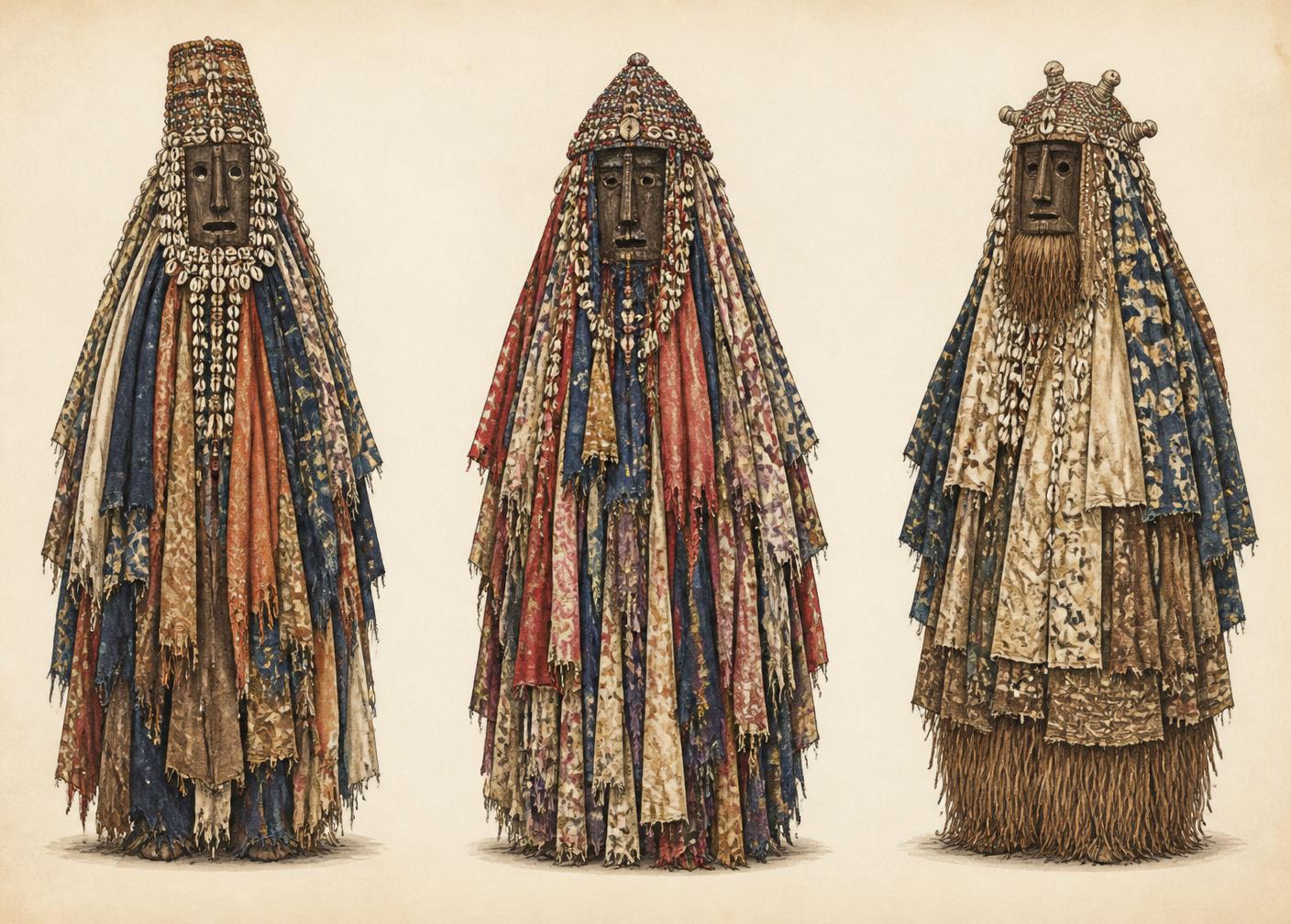
The festival itself proceeds through clearly named movements: Iṣípáyá(the unveiling), Ìjó (the dance), and Ìbùkún (the blessing). At the close, the Egúngún re-enters the family compound and the cloth is respectfully retired until the following year.
3 · Gẹ̀lẹ̀dẹ́ and the power of mothers
Where Egúngún honors the male ancestral line, Gẹ̀lẹ̀dẹ́ honors Àwọn Ìyá Wa — "Our Mothers" — the collective female elders, living and dead, whose spiritual power (àṣẹ) sustains the community. Gẹ̀lẹ̀dẹ́ masks are carved with elaborate scenes on top — markets, animals, news of the day — and danced in matched pairs. The masquerade is performed by men, who dance for the mothers, not as them.
Gẹ̀lẹ̀dẹ́ is famous for its satirical edge: a mask may mock a corrupt official, a careless husband, or a colonial administrator. The festival is, among other things, a public conscience.
4 · Ancestors (Àwọn Bàbá Wa)
In Yoruba cosmology, death is not departure. The dead occupy a parallel dimension (òrun) from which they remain attentive to the living (ayé). The relationship is reciprocal: the living offer libation, song, naming, and remembrance; the ancestors return with counsel, fertility, and protection. Egúngún is the formal moment when that traffic becomes visible.
Crucially, an ancestor is not generic. Each Egúngún belongs to a specific lineage (idílé) and embodies a specific named person. The dance is a re-meeting.
5 · Drums, voice, and bàtá language
The Yoruba drum is not accompaniment — it is speech. The bàtáand dùndún (talking-drum) ensembles can articulate the tones of Yoruba language closely enough to deliver praise poetry (oríkì) and call individual ancestors by name. A skilled drummer can summon a specific Egúngún by playing his praise rhythm.
Hourglass drum set used for òrìṣà Ṣàngó and for Egúngún.
The 'talking' drum; tonal, hourglass-shaped, played under the arm.
Smallest of the dùndún family; conversational, witty, sharp.
6 · Costume and material culture
Costume is theology in cloth. Strips of aṣọ òkè (handwoven cloth), indigo-dyed adire, velvet, beadwork, cowrie shells, and amulets are layered onto a wooden or wicker frame. Materials accrete over generations: a mid-twentieth-century Egúngún may include eighteenth-century fabric. The costume is, literally, ancestral.
- Aṣọ òkèHandwoven strip-cloth, often indigo & gold
- AdireIndigo-resist dyed cotton
- Cowrie shells (owó eyo)Symbols of wealth and ancestral wisdom
- Ìlẹ̀kẹ̀Beaded chains worn around mask and waist
- MirrorsTo reflect and disperse harm
- Amulets (òògùn)Sewn into the inner layer for protection
7 · Community and celebration
The festival is not the performance — the festival is the community. Months before the masquerade dances, women weave new cloth, men carve and repair masks, children learn drum patterns, elders convene to decide which ancestors will be called. Markets restock. Distant relatives travel home. Disputes are settled (or deliberately deferred) so the festival may begin with peace.
The performance proper opens with procession from the family compound to the public square, moves through dance and praise, and closes with a communal meal that may last until dawn.
8 · Glossary
- Egúngún
- Ancestor masquerade; literally 'powers concealed'.
- Òrìṣà
- Divinity within the Yoruba pantheon (e.g. Ṣàngó, Ọṣun, Ọbàtálá).
- Àṣẹ
- Spiritual life-force; the power to make things happen.
- Oríkì
- Praise poetry; a person's or lineage's spoken-sung biography.
- Idílé
- Lineage; the extended family across generations.
- Òrun / Ayé
- The realm of spirit / the realm of the living.
- Bàtá
- Sacred hourglass drum used for Ṣàngó and Egúngún.
- Aláràgbó
- The elder who leads an Egúngún lineage.
- Aṣọ òkè
- Handwoven Yoruba strip cloth, prestige textile.
- Adire
- Indigo-resist dyed cloth, often patterned by tying or stitching.