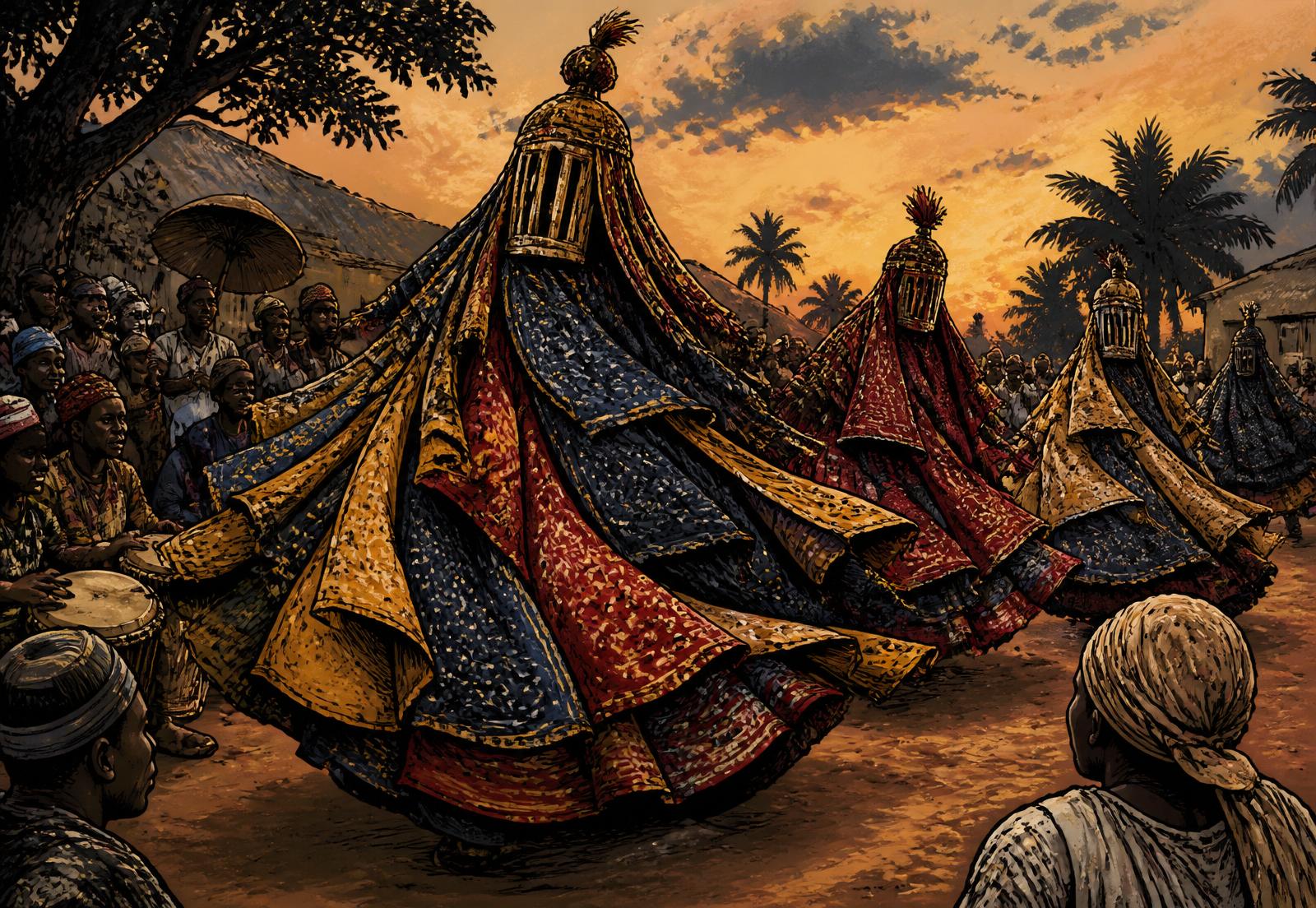
The Ancestors
Are Dancing.
Once a year the dead return — not as memory, but as motion. Cloth, drum, and breath give them a body again. This is a guide to how, and why.
Read it as a book, a wiki, or a journal.
The Egúngún festival is not a museum object. It is a living technology of memory — built from cloth, drum, lineage, and the patient labor of children learning their grandfathers' steps. This site holds three doors into that world. Choose any. They all open onto the same courtyard.
A graphic novel following Tunde, eleven years old, as he helps his grandfather prepare a family Egúngún for the festival that brings the ancestors home.
A wiki-style guide to Yoruba performance traditions: Egúngún, Gẹ̀lẹ̀dẹ́, drums, fabric, lineage, oríkì, and the spiritual architecture of celebration.
A scholarly essay on masquerade as a technology of identity, continuity, and resistance — and on what a dance can hold that an archive cannot.
- — A coming-of-age story in panels
- — Maps of West Africa and the diaspora
- — Costume plates, instruments, glossary
- — A 700-year timeline of performance
- — World echoes: Carnival, Día de los Muertos, Obon
"When the Egúngún dances, he is not a man wearing his grandfather's clothes. He is the grandfather, returned for a season, to bless and to scold."